This paper summarises a panel session delivered in 2002 at the Strategic Management Society conference.
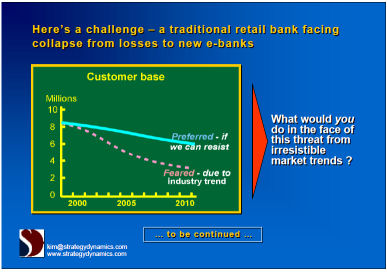
The need for organisations to forecast into the future is a common challenge. One way of improving the view to the future is to incorporate 'scenario dynamics' into the strategy process.
This presentation shows, through a simple example, that management has more to say about its own future than is often assumed. The business environment is not determined wholly by inexorable trends, imposed on firms exclusively by powerful forces beyond their control. Consequently, since neither market forecasts, nor industry scenarios typically feature the strategies and initiatives of firms themselves, these approaches are likely to understate the scope for driving future performance. Instead, the scenario dynamics method illustrated makes possible a rigorous, coherent, and strongly fact-based approach to anticipating and influencing firm’s strategic futures and the evolution of the industries in which they operate.
Sessions 2 and 3 describe two contrasting applications of the approach, each of which illustrated distinctive features that may arise in different cases. Both cases present challenging situations for top management wishing to understand and influence both their own prospects and the industry environment in which they operate.
The first of these is by
James Penney of Darwin Consulting ( www.darwinconsulting.co.uk). James looks at the issue of 'chip migration' - a case that addresses a substantial challenge faced by Visa International, especially in its Central Europe, Middle East and Africa region (CEMEA).
"Whilst there are advantages for the credit card industry to replace cards based on magnetic-stripe technology with cards featuring built-in microchips, it is costly for any group of banks or merchants to take the lead. Visa’s challenge, then, is how to kick-start the migration process."
A presentation from
Lars Finskud of Vanguard Brand Management (www.VanguardStrategy.com) follows. Lars has significant experience in analysis of firms in the pharmaceuticals industry and he talked about their especially intense need to anticipate and drive changes in their industry, since the high-value segment of each product’s life is limited to the period of its patent protection. Moreover, several groups have to be persuaded to migrate to new generations of therapy (doctors, patients, health-management organisations).