In this paper Kim Warren says that there are near-universal expectations that face top management - they, and their investors, expect the organisation’s performance to progress strongly through time...
The challenges facing executives with strategic responsibility (whether the President of Cisco, the head of the Health Service, or the entrepreneur) are large, complex, subtle and constantly changing.
There are no simple answers, so the route to successfully deal with these challenges should be built up from solid fundamentals.
In this paper Kim Warren says that there are near-universal expectations that face top management - they, and their investors, expect the organisation’s performance to progress strongly through time. To do so, management needs to understand historical performance and possible future trajectories, but that this is complicated due to processes of change and the need to constantly revise and update understanding.
For non-profit organisations too, such as charities or governmental bodies, the challenge of performance over time is still fundamental, though it may be expressed in non-financial terms, e.g. number of beneficiaries served, service-levels delivered, etc.
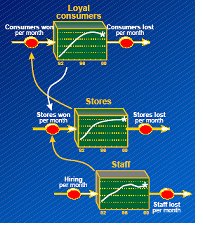
Whist tricky, it is possible to make a difference to the organisation’s fundamental performance, by acting on the inflows and outflows of key performance drivers.
An interdependent system of resources is the heart of every enterprise, where ‘interdependence’ arises from the feedback amongst resources, and it is this set of resources that drive performance.
This download comprises a pdf document showing the slides and notes.
This document may be freely printed, copied, stored or transmitted, provided that it is not changed in any way, and that no charge is made for its distribution.